One Year Warranty Lemon Law Filing: California Guide

California’s Song-Beverly Consumer Warranty Act defines one year warranty lemon law filing as the legal process by which vehicle owners must submit a formal lemon law claim within one year of their manufacturer’s warranty expiration date. This deadline is absolute. Miss it, and you lose your right to a refund, replacement, or cash settlement, regardless of how many times your RV, motorhome, car, or truck visited the dealership for the same unresolved defect. Under California AB 1755, the one-year post-warranty window is the governing deadline, and it applies to every vehicle class the law covers.
What documents do you need for a one year warranty lemon law filing?
Building a strong lemon law claim starts with paperwork. California law requires you to prove the manufacturer had a reasonable number of repair attempts before you assert your rights. That standard is specific: two attempts for serious safety defects, or four attempts for non-safety defects. Alternatively, the vehicle must have been out of service for 30 or more cumulative calendar days. That 30-day threshold is the standard across California and most other states.

Every document you collect becomes evidence. Manufacturers will challenge anything they can, so your records need to be complete and organized before you file.
Gather these documents before filing:
- Repair invoices and work orders: Every visit to the dealership must be documented with a dated invoice showing the defect described, the work performed, and the mileage at drop-off and pickup.
- Service records: The full service history from the dealership’s own system, which you can request in writing.
- Original purchase contract: This establishes the warranty start date and vehicle identification number (VIN).
- Out-of-service log: A personal calendar or log showing every day the vehicle sat at the dealership, not in your possession.
- Photographic and video evidence: Photos of warning lights, physical defects, or damage caused by the recurring problem.
- Correspondence records: Any written communications with the dealership or manufacturer, including emails and text messages.
Precise records are the best predictor of success near the one-year deadline. Manufacturers routinely dispute the number of repair attempts or the severity of a defect. A meticulous log eliminates that argument.
Pro Tip: Store copies of every document in both a physical folder and a cloud-based service like Google Drive or Dropbox. If the dealership loses a record, your copy becomes the controlling document.
How do you send the formal final repair notice correctly?
The formal written notice is the step most California vehicle owners skip, and it is the step that kills more lemon law claims than any other single error. Certified mail with return receipt to the manufacturer’s corporate office is legally required before you file your claim. A conversation with your service manager does not count. An email to the local dealership does not count. Only a formal written notice to the manufacturer’s headquarters generates legal acknowledgment.
Here is exactly how to send it:
- Identify the manufacturer’s corporate address. This is not the dealership address. For Ford, it is Ford Motor Company’s legal department in Dearborn, Michigan. For Thor Industries motorhomes, it is their Elkhart, Indiana headquarters. Look up the correct address in your warranty booklet or the manufacturer’s website.
- Draft the notice letter. The letter must include your full name, vehicle identification number (VIN), a clear description of the defect, a summary of every repair attempt with dates, and a formal request for one final repair opportunity.
- Send via certified mail with return receipt requested. The green return receipt card is your proof of delivery. Keep it with your claim file.
- Allow a reasonable response window. Most manufacturers get 30 days to respond and attempt a final repair. Do not file your claim before this window closes unless the deadline forces you to act sooner.
- Document the manufacturer’s response or non-response. If they ignore the notice, that silence becomes evidence in your favor.
Most manufacturers require this formal final repair opportunity notice before you can proceed. Skipping this step allows manufacturers to argue your claim is premature and move for dismissal. That argument succeeds more often than consumers expect.
Pro Tip: Send the notice at least 60 days before your one-year filing deadline. This gives the manufacturer time to respond and still leaves you room to file if they fail to fix the problem.
What are the steps to file your lemon law claim before the deadline?
Filing a lemon law claim is a structured process, not a single form submission. The California lemon law deadline is one year after your warranty expires, and that clock does not pause for arbitration, negotiations, or delays on the manufacturer’s side. Start early.
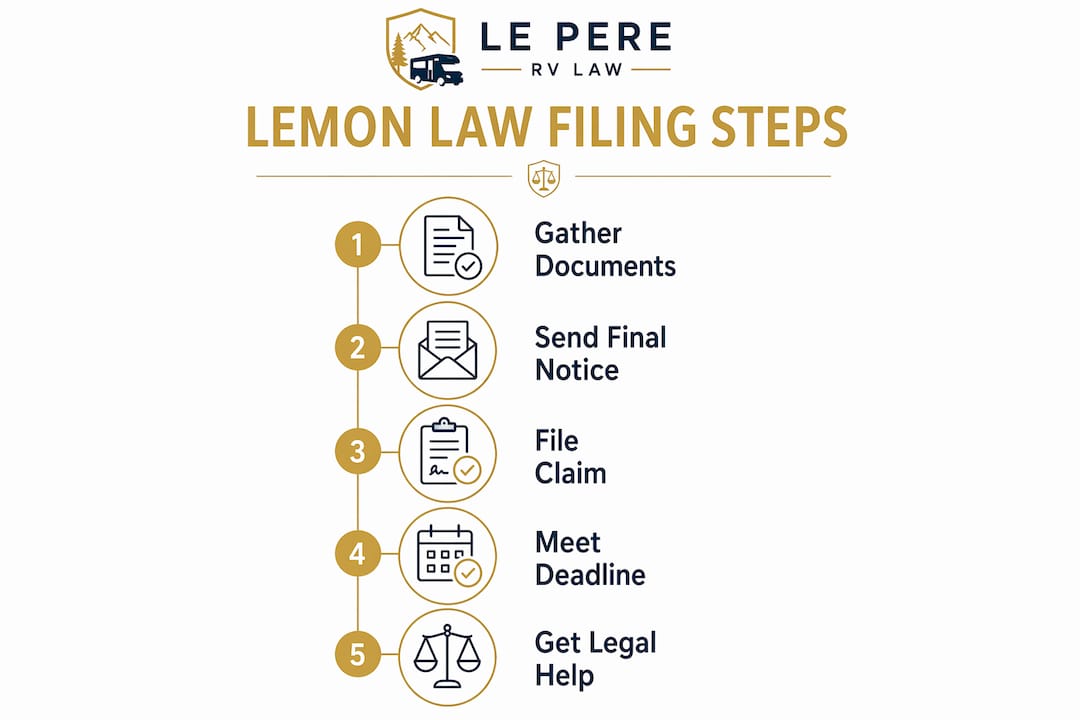
Step-by-step filing process:
- Confirm your vehicle qualifies. The defect must have appeared during the warranty period, and you must have given the manufacturer the required number of repair attempts. California’s Song-Beverly Consumer Warranty Act covers cars, trucks, SUVs, motorhomes, fifth wheels, and travel trailers.
- Compile your complete documentation package. This includes all repair invoices, your out-of-service log, the original purchase contract, and proof of your formal certified mail notice.
- Participate in manufacturer arbitration if required. Programs like BBB AUTO LINE typically take 30–60 days and may be a mandatory step before you can file in court. Arbitration is faster and less expensive than litigation, but it is not always the final word.
- Consult a lemon law attorney. California lemon law is technical. RV claims are even more complex because motorhomes, fifth wheels, and travel trailers carry multiple warranties covering different components. An attorney who specializes in California RV lemon law knows which warranty applies to which defect and how to build the strongest possible claim.
- File your formal claim or lawsuit. If arbitration fails or is not required, your attorney files the claim in the appropriate California court before the one-year deadline.
What you can recover:
- A full repurchase or refund of the vehicle purchase price
- A replacement vehicle of comparable value
- A cash settlement
- A civil penalty of up to two times your actual damages if the manufacturer willfully ignored its warranty obligations
Filing early is the single most important strategic decision you can make. Waiting until the final week leaves no time for document verification, unexpected court delays, or attorney review.
What filing mistakes can sink your lemon law claim?
The most preventable lemon law losses come from procedural errors, not weak defects. California consumers with legitimate claims lose every year because they made one of these mistakes near the filing deadline.
Common errors that kill claims:
- Relying on informal dealer conversations. Only formal certified mail to the manufacturer’s corporate office holds legal weight. Verbal agreements with service managers are not legally binding notice.
- Incomplete repair documentation. Missing a single invoice or failing to log out-of-service days gives the manufacturer room to dispute your repair attempt count.
- Misreading the repair attempt threshold. Two attempts apply to safety defects like brake failures or steering problems. Four attempts apply to non-safety defects. Confusing the two can lead you to file too early or too late.
- Waiting until the last week. The one-year deadline is absolute. Courts do not grant extensions for missed deadlines caused by procrastination or incomplete paperwork.
- Filing against the wrong party. Your claim goes against the manufacturer, not the dealership. Many consumers waste time pursuing the dealer when the legal obligation rests with Ford, General Motors, Winnebago, or whoever built the vehicle.
“Consumers benefit greatly from legal counsel experienced in California lemon law, especially to meet strict one-year filing deadlines and interpret repair attempt rules.” Lemon Law: Complete 2026 Guide
Pro Tip: Contact a lemon law attorney at least 90 days before your one-year deadline. That window gives your attorney time to review your documentation, send the formal notice if you have not already done so, and file before the clock runs out.
Key takeaways
California vehicle owners who act early, document every repair attempt, and send formal certified mail notice to the manufacturer before the one-year post-warranty deadline give themselves the strongest possible position under the Song-Beverly Consumer Warranty Act.
| Point | Details |
|---|---|
| One-year deadline is absolute | California law requires filing within one year of warranty expiration. No extensions exist. |
| Certified mail notice is required | Informal dealer conversations do not satisfy the legal notice requirement. Send to manufacturer headquarters. |
| Repair attempt thresholds are specific | Two attempts for safety defects, four for non-safety defects, or 30+ days out of service. |
| Arbitration comes before litigation | BBB AUTO LINE and similar programs typically take 30–60 days and may be mandatory before court filing. |
| Early attorney consultation protects your claim | Consulting a lemon law attorney 90 days before the deadline allows time for documentation review and proper filing. |
The deadline is the trap, not the defect
After watching hundreds of lemon law cases move through the system, the pattern that stands out is not the severity of the defect. It is the timing. Owners with genuinely defective vehicles, vehicles that spent weeks at the dealership and never got fixed, lose their claims every year because they missed the one-year window by days or weeks.
The manufacturers know this. Their legal teams track warranty expiration dates. They know that a consumer who waits too long has no legal recourse, regardless of how many times the same transmission failed or the same slide-out refused to retract. The deadline is the trap, and the manufacturers count on consumers not knowing it exists until it is too late.
What I have seen work consistently is treating the one-year deadline as a hard project deadline, not a distant concern. The moment your vehicle comes back from its second or third repair attempt with the same problem, start your documentation file. Request your service records in writing. Log every out-of-service day. Send the formal certified mail notice before you think you need to.
RV owners face an additional layer of complexity. A motorhome or fifth wheel carries chassis warranties, appliance warranties, and coach warranties from different manufacturers. Knowing which warranty covers which defect, and which deadline applies to which component, requires experience that most general practice attorneys do not have. That is not a criticism. It is a structural reality of how RVs are built and sold.
The consumers who recover the most, whether through a full repurchase, a replacement vehicle, or a civil penalty settlement, are the ones who treated the filing process as seriously as the defect itself.
— David
Get expert help before your filing window closes
If your vehicle has been back to the dealership multiple times for the same defect and your warranty is approaching expiration, the time to act is now, not next month.

Rvautolegalteam, led by attorney Jeffrey Le Pere, has spent 25 years representing California vehicle and RV owners in lemon law claims statewide. Jeffrey spent 11 of those years on the defense side, building cases for manufacturers. He knows exactly how they fight claims and how to counter those tactics. Every case at Rvautolegalteam runs on contingency, meaning you pay nothing unless you win. The manufacturer covers all fees. Whether you own a motorhome, a fifth wheel, a travel trailer, or a car or truck, you can get a free case review and find out exactly where you stand before your deadline passes.
FAQ
What is the one-year lemon law filing deadline in california?
California’s Song-Beverly Consumer Warranty Act requires you to file your lemon law claim within one year of your manufacturer’s warranty expiration date. This deadline is absolute and cannot be extended.
Does my RV qualify for a lemon law claim?
Motorhomes, fifth wheels, and travel trailers are covered under California RV lemon law if the defect appeared during the warranty period and the manufacturer had a reasonable number of repair attempts. RVs carry multiple warranties, so the qualifying defect must fall under the manufacturer’s written warranty.
How many repair attempts are required before filing?
California law requires two repair attempts for serious safety defects and four attempts for non-safety defects, or the vehicle must have been out of service for 30 or more cumulative calendar days.
Do i need a lemon law attorney to file in california?
You are not legally required to hire an attorney, but legal counsel experienced in California lemon law significantly improves your chances of meeting the strict one-year deadline and correctly interpreting repair attempt rules. Most lemon law attorneys work on contingency, so there is no upfront cost.
What can i recover under california lemon law?
California law allows recovery of a full vehicle repurchase or refund, a replacement vehicle, or a cash settlement. If the manufacturer willfully ignored its warranty obligations, you may also recover a civil penalty of up to two times your actual damages.